
Can puppets reimagine the world?
Publisert 18.november 2026
Publisert 18.november 2026
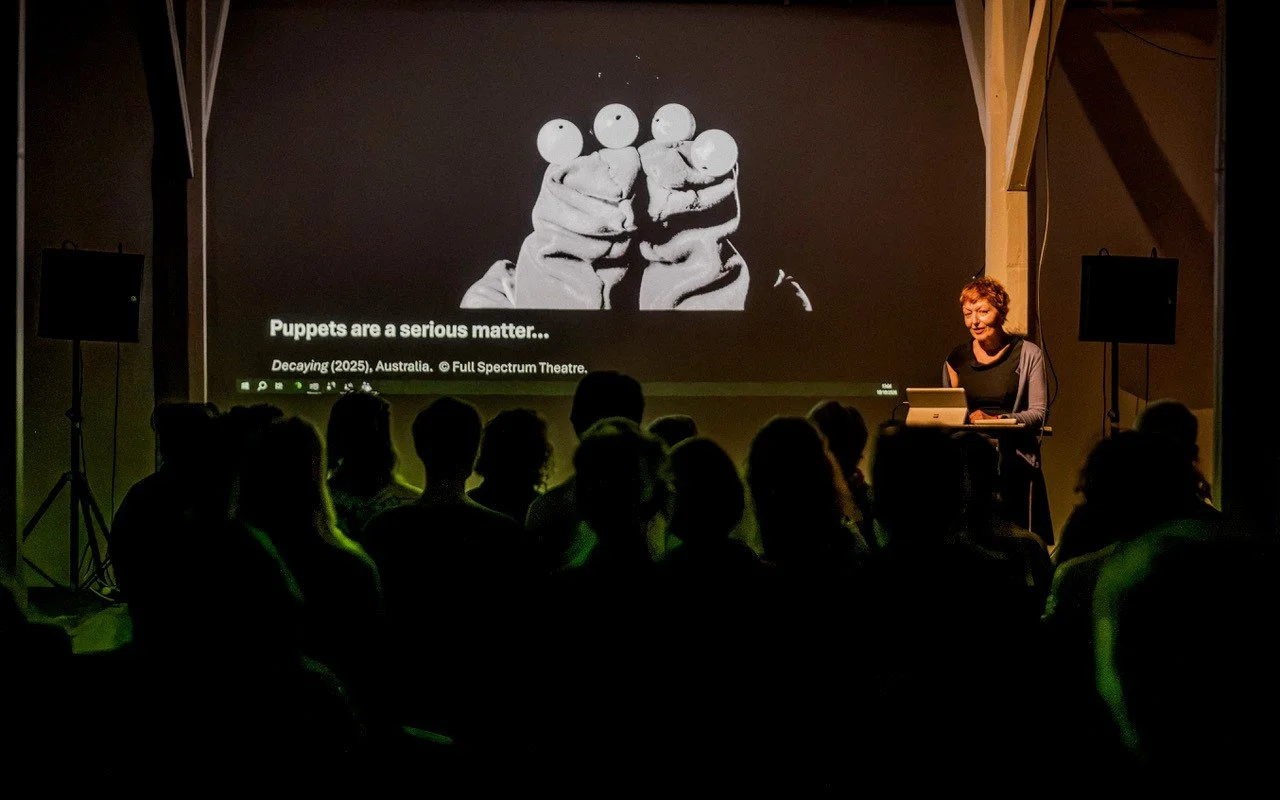
Tekst av Kasia Lech, University of Amsterdam
Holdt som foredrag under Figur i Fossekleiva 10.oktober 2026
Foto: Vendula Hlavackova
Can puppets reimagine the world?
Kasia Lech, University of Amsterdam
Puppets are a serious matter. And I mean matter in more than one sense.
Puppets matter – this is why we gathered on an October afternoon in Berger, Norway, for the Figur i Fossekleiva (FiF) Festival, whose tenth anniversary is further proof of just how much puppets matter.[1]
But the puppets are also matter.
They are made of wood, paper, fabric, metal, plastic, string, foam, or whatever else we can imagine. And each of these materials has its own properties, possibilities, and limitations that shape how a puppet moves, reacts, and interacts.
To work with a puppet is to encounter something different from ourselves. Something that does not have our body, does not necessarily move like us, and does not inhabit space in the same way.
And this difference matters.
Because puppetry requires us to rethink our relationship with the Other. We need to discover what a particular material can do, how it moves, what it resists, and what becomes possible when we work with it. This requires different forms of listening – including listening with our bodies – searching, experimenting, and adapting. And this encounter with the Other cannot mean complete control. And, as I vividly remember from my first encounter with a marionette, sometimes it means no control at all.
But, we do not simply create puppets. We create worlds for them to inhabit.
In this sense, there is something fitting about celebrating puppetry here at Fossekleiva that is an example how matter can acquire new meanings, and a space can begin to function according to different rules. The building was originally the Fossekleven Fabrik textile factory, established in 1889, where raw materials were transformed into fabrics. Today, it is a cultural centre, where those same spaces serve very different purposes.
This reassignment of meaning to and through matter – and the consequent reconfiguration of spatial and relational rules – is at the heart of puppetry. Scenographers work with materials, textures, scales, and spatial relationships to construct worlds that may operate according to very different rules from our own. Puppeteers bring these worlds into being through performance.
Marek Zákostelecký's scenography for Poslední trik Georgese Mélièse (Georges Méliès' Last Trick) at the Czech Divadlo Drak (2013) is an example.[2] Through shadow theatre, projections, costumes, and theatrical tricks, the production creates a world in which bodies and their shadows follow different rules. Shadows move independently of the performers, taking on lives of their own. A bird appears as a shadow without a corresponding living body, while a costume remains suspended in the air after the body that wore it has disappeared. The boundaries between presence and absence, the living and the non-living, become unstable.
In Anna Haudek's scenography for Yemaya – Królowa Mórz (Yemaya – Queen of the Seas) at the Wrocław Puppetry Theatre (2016), the stage becomes a boat carrying a boy and his father fleeing war, while the audience becomes bodies floating in the ocean.[3] The scenography creates two worlds that exist simultaneously: the world above the water and the world beneath it. The father remains on the shore while his son disappears underwater, yet audience can see both worlds at once. Their different scales also coexist: even the molecules of a dinosaur become large enough for spectators to see.
In other words, Haudek's scenography changes the rules of (theatrical) space. Above and below, surface and depth, the microscopic and the enormous are no longer separated. Different realities occupy the same stage, allowing audience to experience multiple spatial relationships and perspectives that would be impossible in everyday world. By allowing spectators to experience different forms of situatedness, the scenography helps the production achieve one of its central aims: inviting audiences to rethink their relationship with otherness.
These examples show how puppetry can challenge what we take for granted about bodies, and their relations to space, time, and even gravity. What appears impossible in our everyday reality becomes possible on stage. As my professor at drama school, the AST National Academy of Theatre Arts in Wrocław, Poland, Mirosława Lombardo, used to say: “Only in puppetry theatre can an actor literally burn for love, night after night.”
So, if puppetry allows us to create bodies and worlds that exist according to different rules, it can also reveal that the rules we consider natural are not the only ones by which a world can be organised. And this brings us back to our relationship with the Other. Because that relation works both ways. Puppets invite us to imagine the Other, but they can also make us recognise ourselves as the Other. From the perspective of a body that does not share our anatomy, movement, or relationship with the world, we are the Other. Thus, puppetry goes beyond imagining a different world. It challenges the assumption that our human way of inhabiting the world is the natural starting point for imagining any world at all.
If puppetry allows us to imagine worlds governed by different rules, why should we assume that the rules governing our own world cannot change?
Obviously, imagining another world does not necessarily mean creating a better one. Nor does puppetry automatically challenge existing power relations. Much depends on what we choose to imagine, who participates in that process, and whose perspectives shape the worlds we create.
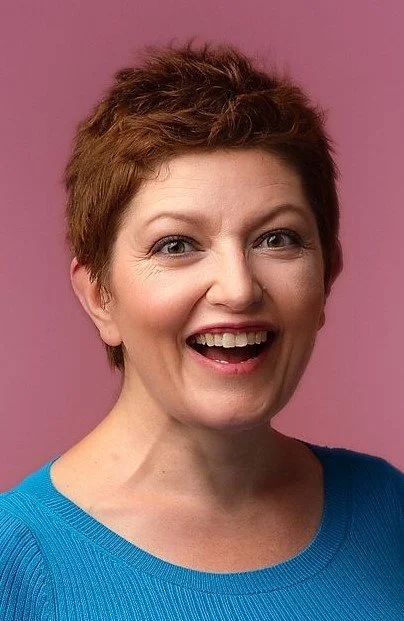
Kasia Lech
Figur i Fossekleiva and Reimagining the World
The 2026 Figur i Fossekleiva festival offered fascinating opportunities to explore these questions. Its programme brought together works that imagined collective futures in which catastrophe had been avoided, questioned control and autonomy, created encounters across historical and cultural boundaries, and explored different political contexts.
The Story of the Day We Prevented the End of the World, a collective project led by Brazilian artist Eduardo Felix, brought together artists from more than ten countries, speaking different languages.[4] The project invited participants to imagine a future in which humanity had already managed to prevent the end of the world. Instead of imagining catastrophe, the participants started from the assumption that catastrophe had been, and therefore could be, avoided.
The resulting installation took the form of a large mechanical wheel, resembling a wheel of fortune, with each section representing a different way of preventing catastrophe. It was a fictional monument commemorating a catastrophe that never happened. Yet its materiality complicated this hopeful premise. The wheel seemed to have a will of its own, deciding when to start rotating without human intervention. As it turned, red lights illuminated its sections one by one, signalling that another opportunity to avert catastrophe had been lost. The sounds produced by its moving materials were deeply unsettling. The unpredictable movement, red lights, and disturbing mechanical sounds created a sense of urgency and threat, suggesting that opportunities to prevent catastrophe were disappearing. Without using words, the installation communicated both the possibility of a different future and the danger of failing to act in time.
Reimagining the world can also mean questioning the rules that govern our most intimate relationships. Another production at the festival, Achter Gesloten Deuren (Behind Closed Doors) by Dutch artist Cat Smits, explored domestic violence and coercive control through documentary puppetry.[5] The abusive man was represented by foam arms that alternately caressed and beat the women. The softness of the foam contrasted with the violence of the actions it performed, unsettling the association between soft materials and gentleness while bringing audiences closer to the women's experience of the same person, and even the same gesture, as both loving and violent. By reducing the man to these actions and allowing the arms to be animated by multiple performers, the production shifted attention away from the individual perpetrator and towards the women experiencing the violence, while also exposing its systemic nature.
One of the women was represented by a puppet animated by the three performers – Urmie Plein, Alexander Brouwer and Cat Smits – in the Bunraku style. The puppet was broken and repaired before our eyes, making the violence and its consequences materially visible. Alexander Brouwer also played her son, who was later suggested to have begun abusing women himself. The relationship between puppeteers and puppet, in which one body is moved and controlled by others, thus became a way of exploring not only coercion, vulnerability, and the gradual erosion of personal boundaries, but also the cycle of violence and how it can be perpetuated across generations. Yet the collective animation and repair of the puppet also raised questions about care and the possibility of recovery.
Another direction was explored in Meeting Baldwin, an interactive performance by Indian puppeteer Varun Narain, now based in Norway.[6] Combining elements of a lecture, a talk show, and puppetry theatre, the performance brought James Baldwin, who died in 1987, back as a life-sized puppet interacting live with the audience. Through this new material presence, Baldwin entered into conversations about race, sexuality, identity, and the freedom to love, challenging the boundaries between the living and the dead. The performance invited the audience to rethink the rules of knowledge itself. Who gets to speak? Who is recognised as a source of knowledge?
These questions also resonated with Elin Osjord's documentary PUPPETRYPOWER (2026), which premiered at the festival.[7] Filmed during the 2025 edition of Figur i Fossekleiva, it featured four puppetry companies working across different cultural and political contexts: Collectif Kahraba from Lebanon, Opposable Thumb Theatre from England, Dafa Theatre from Palestine and Czechia, and Cie La Pendue from France.
Although these works differed in their artistic approaches and political ambitions, they invited audiences to consider what becomes possible when we question the rules we have come to accept.
I want to explore this question further through two productions created by women artists working with children: Kosmiczny pokój (2023) at the Guliwer Puppetry Theatre in Warsaw, Poland,[8] and Bovenkamers (2024) by the Dutch company Tg. Winterberg.[9] This choice is deliberate. Puppetry theatre is often stereotyped as entertainment for children and consequently denied artistic and political significance This devaluation extends to care itself, dismissing its social and political significance and its essential role in artistic practice. In this way, biases against women, children, and care reinforce one another, further marginalising their contributions and denying women and children agency.[10]
Kosmiczny pokój and Bovenkamers challenge these assumptions on several levels. Here, care becomes the basis for alliances in which women artists and children empower one another. Puppetry's material possibilities are central to this process: through objects, puppets, and spaces, children's dreams take physical form, becoming worlds that others can enter, experience, and help shape. Imagining different ways of living together becomes a way of beginning to practise them.
I will start with Kosmiczny pokój, a production for children aged five and above, which premiered on 3 December 2023. And I need to explain the title.
Making Room for Dreams
In Polish, the word pokój means both “a room” and “peace” as the opposite of war. So the title can be understood as The Space Room or The Space Peace, playing with the idea of both a room in the universe and peace in the universe.
The production was created by professional theatre artists working with seventeen children aged seven to fourteen from Polish, Ukrainian, and Belarusian backgrounds, living in Warsaw. About half had refugee background, and all credited as co-authors. The adult team included writer Magdalena Mrozińska, director Kateryna Lukianenko, cultural and educational facilitator Anna Kierkosz, diversity and equality specialist Julia Chrzanowska, and actor Krystyna Velychko, bringing together Polish and Ukrainian perspectives and experiences. The process began in the summer of 2023, with workshops organised as part of the Guliwer Theatre's #połączeni (#connected) project, led by Kierkosz. The children explored what pokój might mean through theatre, objects, music, dance, and multimedia.
One of the early activities laid the foundation for the entire creative process, demonstrating how matter acquires meaning through imagination and collective action, transforming relationships and making space for difference. Each child received a large sheet of paper and was invited to turn it into their own room, furnishing and decorating it however they wished. One boy, for example, dreamt of visiting Japan and filled his room with manga-inspired drawings. The individual rooms were then brought together to form one large, shared space, while retaining their distinct identities.
The children began telling stories about their rooms and dreams. But this was not always easy. The children spoke and understood different languages: Polish, Ukrainian, Belarusian, and Russian, often mixing them in ways that reflected their family histories and the places they had lived. Even children who shared a language did not necessarily use it in the same way. And their familiarity with Polish varied considerably. At first, the adult artists shared their linguistic resources to support children. Velychko spoke Ukrainian, which Kierkosz understood, and they used their language skills to support the conversations. But gradually, the children began translating and interpreting for one another, finding their own ways to make sure that everyone understood enough to take part.
What started with individual sheets of paper was becoming something much larger: a shared world in which the children were learning how to make room for one another, including their different languages and experiences. In other words, they started rehearsing what I have elsewhere described as multilingual gość-inność.
I developed this concept in my book Multilingual Dramaturgies, building on Polish philosopher Cezary Wodziński's concept of “gość-inność”.[11] Wodziński plays with the Polish word “gościnność” (hospitality), separating it into “gość” – meaning “guest” as a noun, but also “host” when used as an imperative verb – and “inność”, meaning “otherness”. At the heart of this idea is the recognition that, whatever else we may or may not share, we can always assume that we are different from one another, and this mutual difference is itself a form of common ground.
I use multilingual gość-inność to describe theatre practices that explore how we might live together through different languages and the different experiences and identities they carry. Rather than treating linguistic differences as barriers to overcome, these practices make them the starting point for collaboration. They challenge divisions between “us” and “them” and invite us to imagine living together not despite our differences, but because of them.
In Kosmiczny pokój, finding ways to include everyone through the different languages spoken in the rehearsal room encouraged the children to visit one another's rooms and, as Kierkosz recalls, begin “dreaming together”. And it all started with a simple sheet of paper. Through the children's imagination, an ordinary material became a room, a space to inhabit, and eventually part of a shared world. This is also what object theatre does: it transforms everyday materials into something else, creating worlds and possibilities that did not exist before.
The children began sharing not only their own dreams but also those of others. For example, the whole group started imagining how the boy fascinated by Japan might actually travel there. Gradually, their individual dreams developed into shared ones. This also took a material form. As the children explored one another's rooms, they began creating a shared space in the middle of the rehearsal room, this time using cushions. Each child had their own cushion, but together they formed a common space where everyone could play and enjoy pillow fights. During one of these pillow fights, a child from Ukraine dreamt out loud: “I would like a world with only pillow wars.”
With the support of the adult artists, the children turned this dream into two songs. The first, Kolęda o pokoju (A Christmas Song about Peace/Room), imagines a world filled with children's laughter during pillow fights and houses whose windows reflect love. The second, Piosenka o naszych marzeniach (A Song about Our Dreams), is multilingual and brings together the children's individual dreams of a world without war: healthy parents, becoming a YouTube celebrity, owning a cat, being rich, living in a clean world, becoming a professional footballer, returning to their home city, or visiting Japan.[12]
Drawing on these workshops and the ideas that emerged from them, playwright Magdalena Mrozińska wrote the script, which the children then read for the actors at the beginning of rehearsals. Their involvement continued throughout the production process, as they contributed to the dramaturgy, scenography, and choreography, and provided feedback on the developing performance.
The production tells the story of eight-year-old Emma, who lives in Warsaw with her mother, while her father has stayed behind in their home country to fight in the war. Emma is represented by a puppet animated by three actors, led and voiced by Ukrainian actor Krystyna Velychko. Velychko also participated in the summer workshops, creating a direct connection between the children's experiences and the performers who brought their ideas to the stage.
Emma feels lonely and struggles to make friends at her new school. After being excluded from another child's birthday party, and having nobody to invite to her own, she makes a wish: “Chcę pokoju na świecie” (I want peace in the world). Her Polish schoolmate Pola, also represented by a puppet (led by Izabela Zachowicz), makes the same wish, but in very different circumstances.
Pola is taking part in a beauty contest to avoid attending classes. During the competition, she delivers an ironic speech criticising beauty contests for reducing women's value to their appearance and wasting time and resources that could be put to better use. Yet, to fulfil the expectations placed on beauty contestants, she ends with the familiar, almost obligatory wish for world peace. The jury mechanically applauses, completely missing her criticism. Her attempt to express a political opinion, her political agency, is ignored precisely because she is a child, a woman, and a beauty contestant.
Both wishes are however heard by Wielkie Oko (the Great Eye), the spirit of Emma's telescope. In Kosmiczny pokój, the spirits of different objects work for Gwiazdka z Nieba – literally “Star from the Sky” or “Star from Heaven,” a Polish expression associated with the fulfilment of one's greatest wishes. The Great Eye has only just started their career as a wish-granting spirit. Eager to impress, they take on a wish marked as level ten, so the most difficult to fulfil, but they misunderstand “pokój na świecie” (peace in the world) as “pokój we wszechświecie” (a room in the universe). And so Emma and Pola find themselves in a strange room suspended in space, somewhere between Mars and Jupiter.
In the space room, Emma and Pola encounter various objects carrying their own stories of displacement. There is a Blue Couch (Honorata Zajączkowska), left behind in London by a family of Polish migrants who returned to Poland. There is a toy Unicorn (Tomasz Kowol) who has lost its horn and, with it, believes it has lost its magic. And there is a Flower (Wojciech Parszewski) who left its small town for Warsaw because it dreamt of meeting the famous Palm. The Palm is important here.
In 2002, Polish artist Joanna Rajkowska installed a life-sized artificial palm tree in the middle of a busy roundabout in central Warsaw. Entitled Pozdrowienia z Alej Jerozolimskich (Greetings from Jerusalem Avenue), it referred to Warsaw's lost diversity and its contemporary realities.[13] Intended to stand for just one year, the palm initially provoked public outrage. Some complained that it had replaced a traditional Christmas tree and simply did not belong in Warsaw. Yet, more than twenty years later, it has become an inherent feature of the city. Something once seen as foreign and out of place has become part of what Warsaw is. Like the displaced objects in Kosmiczny pokój, the palm raises questions about belonging and how our understanding of what belongs can change.
But displacement in Kosmiczny pokój is not only spatial. The Great Eye is also displaced, but from language. As a non-binary character, the Great Eye needs to stretch the grammatical rules of Polish, a deeply gendered language in which even the word “non-binary” has masculine (niebinarny) and feminine (niebinarna) forms, to express its identity, also in plural (niebinarni/niebinarne). Language activists have proposed various gender-neutral forms, but all of them require stretching or breaking the grammatical boundaries of standard Polish. In Kosmiczny pokój, language itself becomes a malleable material, stretched and reshaped to make room for the Great Eye.
Children in the audience are invited to practise such stretching from the very beginning. When Emma wakes up in the strange room, she tries to name the things around her. She does not know the Polish words for some of them, so she asks the children in the audience for help. Emma speaks Polish with a Ukrainian accent, suggesting that the language she now speaks is also new to her. The children in the audience are therefore invited to rehearse what it means to host someone in their language, extending multilingual gość-inność from the workshop process into the performance.
In turn, the production is filled with the experiences of children whose lives have been changed by war, whether through their own displacement or through new people arriving in their schools and communities. Difficult emotions – fear, a sense of abandonment, sadness – are shown and validated through these stories. At the same time, it is by drawing on these different and combined experiences that Emma, Pola, and the displaced objects find their way home and towards friendship.
This is not about finding a silver lining in the tragedy of war, but about offering hope. Moreover, by giving feelings, voices, and accents connected to displacement a place on stage, the production makes a statement that they are part of Poland's culture. It imagines solutions to communal problems emerging from the different perspectives and experiences of displacement and marginalisation. As Emma and Pola find their way home, together with the lost objects, they paint a vision of Warsaw as a multilingual city where things that once seemed foreign and out of place – like the palm in the city centre – become an inherent part of the city and its communities.
This imagining extended beyond the fictional world of the performance. In creating the production, children with different languages, histories, and experiences found ways to communicate, translate for one another, and dream together. They also co-organised and co-led a press conference at the premiere, demonstrating their creative agency in shaping the production and speaking about the world around them and its future.
And this brings me back to my question about worlds governed by different rules.
In Kosmiczny pokój, a linguistic misunderstanding turns a wish for peace into a room in space, where displaced objects speak and a non-binary Eye stretches the grammatical rules of Polish. What seems like a mistake opens up possibilities for imagining a different reality.
The production does not stop at imagining another world. Through their imagination, languages, and collaboration, the children have already begun building one, practising how to live together because of their differences rather than despite them. At the end of the performance, the adult actors turn this into a promise as they sing: “Zbudujemy im ten pokój.” In English, this means both “We will build them this room” and “We will create this peace for them.” A promise to help make that world possible beyond the theatre.
Kosmiczny pokój shows what it means to take children's dreams seriously and give them room and material form. This question is also at the heart of Bovenkamers. The project began with conversations with 250 primary school children in the Zaanstad region of the Netherlands – where primary school covers ages four to twelve – about their feelings, worries, problems, and dreams. As Marlyn Coetsier, the show's creator, explains at the beginning of each performance, the starting point was a simple idea: a wish is a problem turned inside out. Rather than simply asking children what they wanted, the artists invited them to talk about their worries and imagine what would happen if these could be turned into wishes. These conversations became the basis for the Bovenkamers installation.
The entire experience takes place inside a yurt. To enter, visitors have to take off their shoes and step inside in their socks. This simple gesture marks a transition: the audience is entering someone else's space and is invited to treat it with respect. It is another form of gość-inność, in which entering someone else's world begins with recognising that it is different from their own.
Inside is a miniature city of 35 houses, reminiscent of dollhouses, filled with dioramas, animations, stop-motion films, and mechanical installations. On entering, each spectator receives a house number and headphones. They then move independently through the miniature city, exploring a selection of houses and listening to stories, poems, and music inspired by the children's thoughts and wishes. Visitors can also choose two pairs of headphones, allowing them to share a child's dream with someone else or experience it on their own.
Each house has its own world, its own atmosphere, and its own rules. All based on a dream. And these are very different dreams. There is a house where nightmares can be sucked away, so you no longer have to be afraid of the dark. There is a house where nobody dies and sick people get better. There is a room where you can receive a standing ovation. And there is a house where you can cry and even the walls cry with you. These are worlds in which the usual rules of reality no longer apply, allowing children's wishes to take material form.
But some of these dreams require the audience to bring them into being. For example, one boy dreams of being tall. In his miniature world, he can grow so tall that he reaches the clouds. But for this to happen, a spectator must turn a crank and make the little figure grow. Another child dreams of a house filled with sweets. At this house, every visitor receives a sweet. The dream becomes something the audience can physically experience, even taste. And through this, the child, although not physically present, shares their dream with the spectators.
And this is where the installation goes beyond representing children's dreams. It invites the audience to enter these dreams with respect and care, listen to them, and sometimes participate in them or help make them happen. Through puppets, objects, and physical interactions with them, what begins as an individual child's worry, problem, or wish becomes an opportunity to dream together and help create a world in which someone else's dreams can come true.
This brings me back to Kosmiczny pokój. There, children began by creating individual rooms from sheets of paper. These rooms were then joined into one shared space, and the children began visiting one another and dreaming together. In Bovenkamers, each child's dream also has its own room, its own world. But these worlds are not closed or entirely private. Spectators can enter them, listen to the stories, share the experience, and sometimes help bring the dreams into being. In Kosmiczny pokój, the adult performers end with a promise to help make the children's imagined world possible. In Bovenkamers, this invitation to participate in realising children's dreams extends to the audience itself, children and adults alike.
In both productions, puppets and objects give children's dreams, experiences, and voices a material presence, something others can enter, encounter, touch, change, or even taste. But the children's agency goes beyond having their experiences represented. Their perspectives actively shape not only the artistic worlds created on stage but also the possibilities for imagining a different world beyond it. In this sense, their artistic agency is also political.
And this is where the work of women artists becomes particularly important. In these productions, care does not mean speaking for children or deciding what is best for them. It means creating the conditions in which their voices can be heard, their ideas taken seriously, and their dreams shared with others. Through these collaborations, different ways of living together are not only imagined, but also practised.
Puppets are a serious matter. And perhaps what makes them so serious is that they invite us to question not only what our world is made of, but also who it is made for.
[1] This eleventh edition marked a decade of the festival, which first happened in 2016.
[2] Poslední trik Georgese Mélièse (Georges Méliès' Last Trick), directed by Jiří Havelka, with scenography by Marek Zákostelecký. Divadlo Drak, Hradec Králové, Czech Republic, 2013, https://draktheatre.cz/en/repertoar/georges-melies-last-trick/. Trailer: https://www.youtube.com/watch?v=decgUXSLvks.
[3] Yemaya – Królowa Mórz (Yemaya – Queen of the Seas), directed by Martyna Majewska, with scenography by Anna Haudek. Wrocławski Teatr Lalek, Wrocław, Poland, 2016, https://teatrlalek.wroclaw.pl/pl/component/sppagebuilder/63-yemaya-krolowa-morz. Trailer: https://www.youtube.com/watch?v=7P3UiA4zZ40.
[4] The Story of the Day We Prevented the End of the World, an international collective installation led by Eduardo Felix. Figur i Fossekleiva, Fossekleiva kultursenter, Berger, Norway, 2026, https://figurifossekleiva.no/event/the-story-of-the-day-we-prevented-the-end-of-the-world-2/.
[5] Achter Gesloten Deuren (Behind Closed Doors), written and directed by Cat Smits, with dramaturgy by Maja Hertoghs and scenography by Tessa Verbei. Cat Smits Company, Netherlands, 2026, https://catsmitscompany.com/en/voorstellingen/behind-closed-doors/. Trailer: https://www.youtube.com/watch?v=dFTNvIeBzIY.
[6] Meeting Baldwin, created and performed by Varun Narain. Figur i Fossekleiva, Fossekleiva kultursenter, Berger, Norway, 2026, https://varunpuppeteer.simdif.com/about_me.html.
[7] PUPPETRYPOWER, documentary film directed by Elin Osjord, featuring Collectif Kahraba, Opposable Thumb Theatre, Dafa Theatre, and Cie La Pendue. Elin Osjord Vision, Norway, 2026, https://www.drammensacred.no/program/puppetrypower/.
[8] Kosmiczny pokój (The Space Room / The Space Peace), directed by Kateryna Lukianenko, with text by Magdalena Mrozińska and a creative process involving seventeen Polish, Ukrainian, and Belarusian children, facilitated by Anna Kierkosz. Teatr Lalek Guliwer, Warsaw, Poland, 2023, https://teatrguliwer.pl/spektakl/kosmiczny-pokoj/. Trailer: https://www.youtube.com/watch?v=xyE39C-Cilc.
[9] Bovenkamers, conceived and directed by Marlyn Coetsier, with miniature houses created in collaboration with Teun Creates. Tg. Winterberg, Netherlands, 2024, https://tgwinterberg.nl/voorstelling/bovenkamers. Trailer: https://www.youtube.com/watch?v=ZFC8dVFC9xY.
[10] For further discussion, see Jeanne Klein, ‘From Children’s Perspectives: A Model of Aesthetic Processing in Theatre’, Journal of Aesthetic Education 39, no. 4 (2005): 40–57; Manon van de Water, Theatre, Youth, and Culture: A Critical and Historical Exploration (New York: Palgrave Macmillan, 2012); Katarzyna Chajbos-Walczak and Zofia Małkowicz, Badanie środowiska osób zajmujących się sztukami performatywnymi i literaturą dla dzieci i młodzieży (Poznań: Centrum Sztuki Dziecka, 2024); Ewa Bal and Kasia Lech, Feminist Imagining in Polish and Ukrainian Theatres (Cambridge: Cambridge University Press, 2025).
[11] Kasia Lech, Multilingual Dramaturgies: Towards New European Theatre (Cham: Palgrave Macmillan, 2024); Cezary Wodziński, Odys gość. Esej o gościnności (Gdańsk: Fundacja Terytoria Książki, 2015).
[12] Kolęda o pokoju (A Christmas Song about Peace/Room) and Piosenka o naszych marzeniach (A Song about Our Dreams), songs co-created with children during the #połączeni project. Teatr Lalek Guliwer, Warsaw, Poland, 2023. Kolęda o pokoju: https://www.youtube.com/watch?v=1w9x_xIf-Ls; Piosenka o naszych marzeniach: https://www.youtube.com/watch?v=Ad_vulULd0s.
[13] Pozdrowienia z Alej Jerozolimskich (Greetings from Jerusalem Avenue), a public art installation by Joanna Rajkowska, featuring an artificial palm tree at Charles de Gaulle Roundabout, Warsaw, Poland, 2002, https://www.rajkowska.com/en/pozdrowienia-z-alej-jerozolimskich/.